Supervisory Technology, or SupTech, is the use of technology by financial supervisors to become more data-driven. According to the Financial Stability Board (FSB), SupTech is any application of fintech used by regulatory, supervisory, and oversight authorities. That is, it can be applied across a range of functions at supervisory authorities, or be strictly applied to supervisory processes.
SupTech enhances the ability of supervisors to support financial inclusion while ensuring stability and consumer protection. Its adoption is growing rapidly worldwide, and while advanced economies currently lead in implementation, emerging economies are closing the gap. SupTech tools are applied across various organisational functions and supervisory topics, and could fundamentally transform how supervisors operate.
SupTech is not only the key to inclusive DFS, but it also helps foster better and more data-driven supervisors. It increases the ability of supervisors to support financial inclusion while keeping the financial sector stable and consumers protected.
The State of SupTech Report released by the Cambridge Centre for Alternative Finance (CCAF) in early 2025 reveals the real scale of SupTech adoption. In 2024, 164 supervisors in 105 countries had at least one live SupTech implementation.
Advanced economies are leading the way, with 75% of their supervisors using SupTech. This is compared to 58% of supervisors in emerging economies. But this adoption gap of 17% is actually reducing, and was 25% in 2023.
CCAF organises SupTech solutions into ‘supervisory data layers’:
- Data collection
- Data processing
- Data storage
- Data analytics
- Data products
Different types of technologies (or SupTech generations) can power these layers. Technologies can vary from traditional technologies, such as improvements to relational databases, to cutting-edge AI-powered applications that use machine learning, large language models, and other tools.
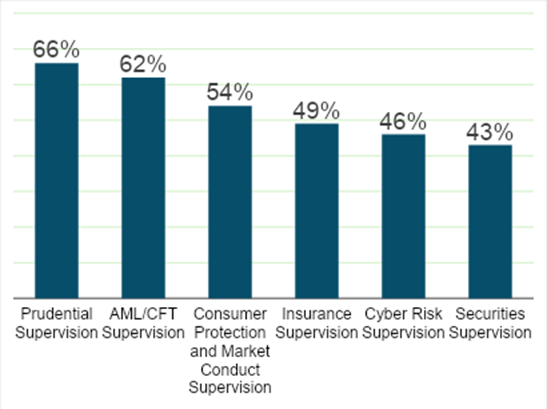
According to CCAF, the most common supervisory use cases cover the following areas:
- Prudential supervision [66% of the surveyed supervisors]
- AML/CFT supervision [62% of the surveyed supervisors]
- Consumer protection and market conduct supervision [54% of surveyed supervisors]
Other areas that are also using SupTech tools include insurance supervision, cyber-risk supervision, and securities supervision:
However, to fully benefit from SupTech, supervisors must treat it as a strategic investment that extends beyond just acquiring new technology tools. Success requires a comprehensive digital transformation strategy, a robust data governance framework, and a clear, process-focused SupTech plan that is supported by senior leadership.
Critically, the decision and implementation of SupTech must be aligned with the workforce strategy and a shift towards an organisational culture that fosters innovation. Ultimately, SupTech serves as a powerful catalyst but cannot replace the essential foundation of a strong, risk-based supervisory approach.
Let’s explore how SupTech can be leveraged by supervisors and supervisory authorities.
If you have trouble playing this video, you can access an alternative player here.

You now have an understanding of the need to make strategic decisions about SupTech investments. You should also be aware of how SupTech relates to broader digitalisation strategies and data reform strategies.
In the next section, we look at specific opportunities and challenges created by AI-powered SupTech tools.
 Additional Reading:
The following sources were consulted in preparing this video. We suggest that you include these as additional reading as you proceed through this course.
- Cambridge SupTech Lab, 2025, Cambridge Cenre for Alternative Finance, State of SupTech Report 2025.
- Dias, D. 2026. Upcoming Publication
- Dohotaru, Matei; Prisacaru, Marin; Shin, Ji Ho; Palta, Yasemin, 2025, Prosperity Insight Series © World Bank, AI for Risk-Based Supervision: Another Nice to Have Tool or a Game-Changer?.
 Reflection Questions for Discussion
Think about a significant pain point or inefficiency in your current supervisory process:
- What is one SupTech application that could address it?
- More importantly, what is the most critical non-technological change—whether in your team’s skills, internal culture, or existing workflows—that would be required to ensure that technology implementation succeeds?